How to Identify the Invisible Tug-of-War and How to Work with Your Neurotype
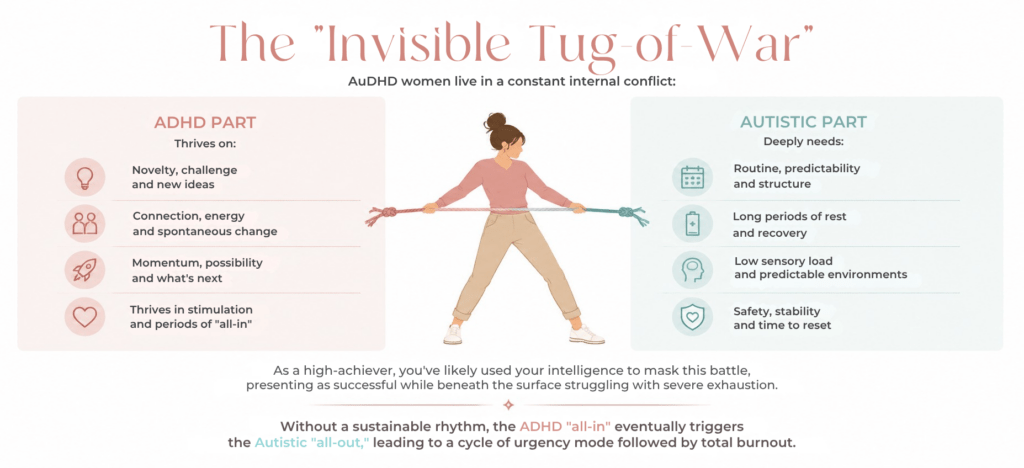
Do you ever feel like you’re stuck on a see-saw? One minute you’re in superdrive of hyperfocus, where the rest of the world disappears, and you’re a productivity powerhouse. Then, suddenly, you hit a heavy “brick wall” of complete shutdown, and overuse turns into burnout, and even the tiniest decisions feel overwhelming.
I am seeing more and more of this internal struggle with incredible women who are, for all other metrics, highly successful. I don’t believe there is a sudden occurrence of this tug-of-war; I do believe there is a new level of understanding that finally gives these amazing women a space to be heard and understood.
This isn’t a lack of systems or discipline. It’s the biological reality of your unique mind navigating structures that don’t work with you. So let’s go beyond why your AuDHD brain flips from all-in to all-out and find your unique flow for your uniqueness.
The ADHD High-Gear: Hyperfocus
For those with ADHD, you’ll be very aware of your “interest-based” engine. You don’t lack attention; you have a challenge regulating it. When a task is novel, challenging, or deeply interesting, the brain floods with the stimulation it craves, which can lead to hyperfocus. In this intense concentration, you lose all track of time and other important objectives in that moment.
While hyperfocus can feel like a “superpower,” it’s often a high-intensity sprint that consumes massive amounts of your cognitive fuel without a reset plan.
The Autistic Brake: Shutdown
If ADHD is the accelerator, Autism often acts as the brake. When you are pushed past your limits—through sensory overload, emotional exhaustion, or the heavy cognitive load of social camouflaging (masking)—your nervous system triggers a shutdown.
In our sensory-heavy world, noise, bright lights, and textures act as a constant “background drain” on your energy. A shutdown isn’t “laziness”; it is a vital protection mechanism for a nervous system that has gone beyond its limits of safety.
Make the Shift from Time to Energy Management
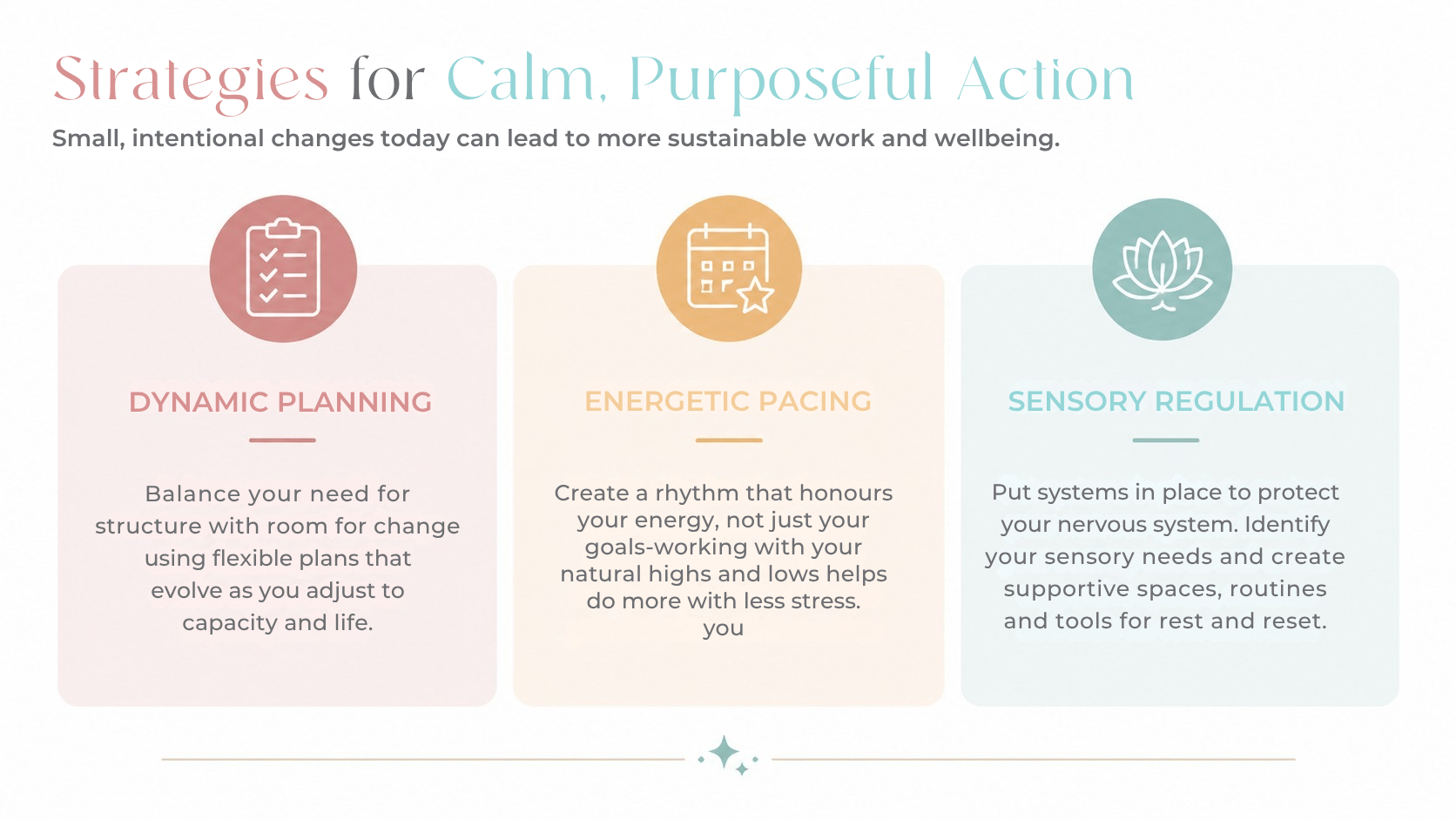
Most strategies and tools for managing your life and tasks fail because they assume a linear, consistent flow of energy. Embracing your uniqueness, we can make real change with an outside the box approach:
- Self-Care is a “Cognitive Performance Strategy”: Nourishing your brain through sleep, movement, and sensory “resets” is what fuels the regions responsible for starting and shifting tasks.
- The “Full Arc” Strategy: When you plan a task, don’t just plan the “doing.” Plan the transition in (getting into gear), the execution, and—most importantly—the cleanup and reset phase to support your cognitive load.
Stand in Your Authentic Power
You don’t need to “fix” your brain; you need to honour your neuro-native state. Sustainable success comes from doing less intentionally so you can achieve more with clarity and joy.
Ready to find your authentic rhythm?
Let’s have a conversation to see if we are the right fit. Stop going around in circles and finally stand in your authentic power.
Together, we can explore what’s really going on beneath the overwhelm and find ways of working that support your unique ADHD or AuDHD brain — rather than constantly working against it.
References & Further Reading
- A Neuroaffirmative, Self-Determination Theory–Based Psychosocial Intervention for Adults With Attention-Deficit/Hyperactivity Disorder: Randomized Feasibility Study – Champ RE, Meneses RW, Adamou M, Gillibrand W, Arrey S, Tolchard B A Neuroaffirmative, Self-Determination Theory–Based Psychosocial Intervention for Adults With Attention-Deficit/Hyperactivity Disorder: Randomized Feasibility Study JMIR Form Res 2025;9:e69943 doi: 10.2196/69943 PMID: 41161339 PMCID: 12612647
- The Different Signs Of AuDHD In Women & Girls – Augmentive
- The High Achieving Woman’s Guide to AuDHD
- Unpacking the overlap between Autism and ADHD in adults