Have you ever stood in the middle of your living room, surrounded by tasks, feeling completely, physically frozen?
You look at the pile of paperwork on the dining table, the laundry waiting to be folded, and the mountain of unread emails. Your brain instantly tries to calculate all forty-seven steps required to fix the entire house, gets hit by a wall of sensory noise, and simply shuts down.
I get it. The standard systems and tools that we learn aren’t designed for the way your unique mind works, and living in constant “urgency mode” is exhausting.
When we are late-diagnosed with ADHD as mature adults or women in leadership, we often carry decades of accumulated shame. We fall into “Destination Syndrome”—the toxic belief that we will only be allowed to rest, feel worthy, or be happy once everything is 100% organised and complete. When standard planners and traditional “tidying tips” fail us, our Inner Judge steps in with a cruel narrative: “Why can’t you just get it together?”
But here is the truth: your brain isn’t broken. You don’t need another generic productivity hack. You need a framework that honours your nervous system and moves you from high-cortisol paralysis into calm, sustainable flow.
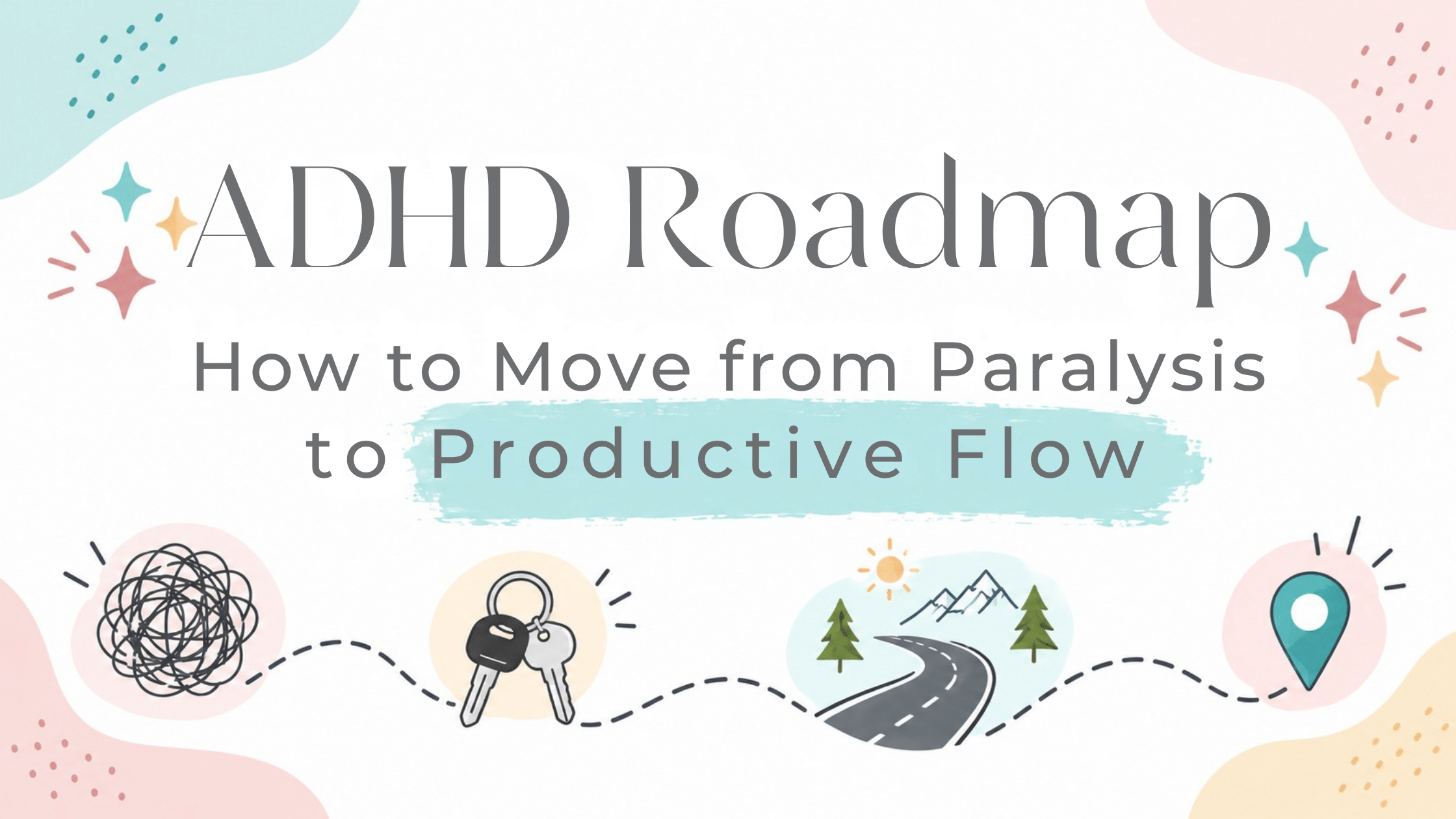
In my coaching practice at Outside the Box Coaching, we use a powerful, neuroaffirming concept to help late-diagnosed adults rebuild self-trust: The Road Trip Metaphor.
Here is how you can use this roadmap to take back the steering wheel and become the leader of your own life.
1. Identify Your Starting Point: “Finding the Keys”
Imagine you are packed and ready to go on an epic scenic drive, but you can’t leave the driveway because you can’t find your car keys.
When you experience ADHD task initiation paralysis, you are trying to drive the car without the keys. Your brain views the “destination” (cleaning the entire house) as a massive threat response.
To break paralysis, lower the executive demand by defining “finding the keys” as an absurdly small, low-stakes micro-action.
- Finding the keys isn’t cleaning the room: It is deciding what you want the space to feel like.
- Shrink the start: Instead of tackling a whole room, “finding the keys” might mean gathering up five pieces of visible rubbish or clearing just the top of one dresser.
- Bypass “Rut” Anxiety: When you view starting as merely looking for your keys, you realise you aren’t “stuck in a rut” or failing—you are simply in the preparation phase.
The Coaching Shift: When you feel frozen, practice Notice, Label, and Shift. Notice that you are spiralling. Label the voice: “Ah, that’s my Inner Judge telling me I have to be perfect today”. Then Shift your focus to self-compassion and ask: “What is the smallest micro-action that represents finding my keys right now?”
2. Build Safe Momentum: “The On-Ramp”
Once you’ve found your keys and started the engine, how do you merge onto the highway?
Too often, ADHD adults rely on an “Adrenaline Blitz”—waiting until panic spikes our cortisol so high that we try to launch from 0 to 100 km/h instantly. The result? We blow out our engine, end up exhausted on the couch, and feel even more shame.
Instead, you need a sensory-safe On-Ramp that lets you accelerate slowly:
- Remove Barricades: Before you try to merge, clear away physical and sensory friction points. Put on your noise-cancelling headphones, queue up your favourite podcast, and bring the rubbish bin directly into the room.
- Start in Low Gear: Begin with small, familiar, or nearly finished tasks (like loading the dishwasher or putting away three obvious items). This releases a gentle hit of dopamine, easing your executive functions into motion.
- Shift into Cruise Control: As your speed builds smoothly, transition into low-effort daily habits that keep momentum going without draining your mental battery.
3. Check Your Fuel & Choose the Next Logical Road
When decision fatigue sets in and you don’t know what to do next, the Road Trip metaphor acts as your personal GPS:
- Check Your Fuel Tank: Before taking on a tough stretch of road, ask yourself if your car is “serviced”. Have you eaten? Are you hydrated? Do you have the physical energy required for this task?
- Pick the Next Logical Road: Stop second-guessing and trying to map out the next fifty kilometres. Focus on just one road or one category at a time—like sorting only the reusable bags—because it gives you the highest impact for the least effort.
4. Plan Your “Exit Ramps” & Redefine Rest
A sustainable road trip requires planned rest stops. Yet for many neurodivergent adults, lying in a quiet room doing “nothing” triggers immense guilt while our internal thoughts continue to race.
Through Journey Thinking, we reframe rest from a reward you must “earn” into an essential, non-negotiable pitstop:
- Take Your Exit Ramps: Plan your stops before you start driving. Decide in advance: “I am going to work on this space for 20 minutes, and when my timer goes off, I am taking my exit ramp without guilt”.
- The Secret Third Option for Rest: If doing “nothing” makes your nervous system feel anxious, seek controlled, supportive stimulation. Engage in low-demand, regulating activities—like gentle somatic movement, listening to music, or stepping outside with a sensory fidget—that allow your mind to refuel peacefully.
- Embrace Detours: Life happens. When unexpected stressors or family needs arise, a detour isn’t a failure—it’s simply a temporary change in route on a journey you are still navigating with grace.
Standing in Your Authentic Power
Organising your home and life isn’t about buying expensive matching baskets or forcing your mind to fit rigid, neurotypical expectations. It is about building self-trust.
When you shift from destination thinking to journey thinking, you stop waiting for a distant “perfection” to start enjoying your life. You realise that you have the map, you know how to find your keys, and you are fully capable of navigating whatever comes your way.
Are you ready to stop going around in circles and find your authentic rhythm?
If you are ready to move out of urgency mode and build a calm, purpose-filled life tailored to your unique mind, let’s talk about how 1:1 ADHD coaching can support your journey.