Finish Strong ADHD Style: How to Bring Your Passions to Life with Energy to Spare

I used to believe that finishing meant pushing harder and ignoring every new idea that popped up. It never worked. In this blog, I share what actually helps ADHD brains finish strong—by working with your creativity, not fighting it.
You know that feeling when a lightning bolt of inspiration hits? For the first quarter or maybe even half of the project, you are unstoppable. In fact, you might be in full ADHD hyperfocus mode, and you can’t imagine doing anything else.
 
The vision is crystal clear, and the excitement is high. But then, it happens. A new idea flashes by—shinier, fresher, and even more exciting—and suddenly, your current project feels stale.
 
You find yourself left with a graveyard of half-finished brilliance and a battery that’s permanently in the red.
 
For a long time, I thought “focus” meant suffocating my creative nature and digging deep for more willpower and discipline.
 
I believed that to finish one thing, I had to ignore every other spark of inspiration that came my way. It made the process feel like a hard slog, and by the time I got close to the finish line, I was too exhausted to actually enjoy it.
 
And for many of the ADHDers I coach, they tend not to get to the finish line at all.
But here is the secret:

You don’t need a rigid cage for your ideas; you need a structure that lets your creativity flourish while you maintain momentum on the one passion project you’re bringing to life.

You can cross the finish line without fighting your nature—and actually have energy left in the tank when you get there.

Understanding ADHD: What Gets in the Way of Finishing Strong ADHD Style

To get to the place where you can implement a structure to finish strong, ADHD-style, a shift in perspective might help you see what is really getting in the way.
 
We can use the Brown Model of Executive Functions to help us identify where things might be getting in the way, and later, we’ll look at how your strengths of ADHD can shape your structure for finishing strong.
 
Dr Brown states in this ADDitude article on motivation, “Recent research offers considerable evidence that ADHD is not a ‘willpower thing,’ even though, in many ways, it appears to be a lack of willpower.
 
When individuals with ADHD are faced with a task that is really interesting to them, not because someone told them that it ought to be interesting — but because it is interesting to them at that moment — that perception, conscious or unconscious, changes the chemistry of the brain instantly. This process is not under voluntary control.”
 
The Link Between Emotions and Working Memory
He goes on to explain the intricate link between emotions and working memory as key factors for the level of motivation to start or stick with a task or project.
 
“Social psychological research has shown that individuals with larger working memory capacity are generally better able to deal with emotions, pleasant and unpleasant, without getting excessively caught up in them.
 
Those with ADHD tend to have less “bandwidth” in their working memory functions and are likely to have more difficulty than others in quickly linking together various memories relevant to doing or not doing a task. They are less likely to take into account the bigger picture of which the present moment is a part of.”

From this understanding, we can take a new perspective on how we manage our creative passions and build a structure that helps an ADHDer finish strong.

  • Releasing guilt, self-blame, or shame for not being able to stick to a single project reduces these negative emotions, supporting motivation and inspiration.

 
  • Interest is not voluntary, so exploring additional interests is not a failure of focus for the original passion project; it might be a case of returning to the project’s original passion.
 
  • Supporting working memory with external structures can link you back to the bigger picture.
How might these statements shift your perspective on what is getting your way?

What You Need to Finish Strong ADHD Style

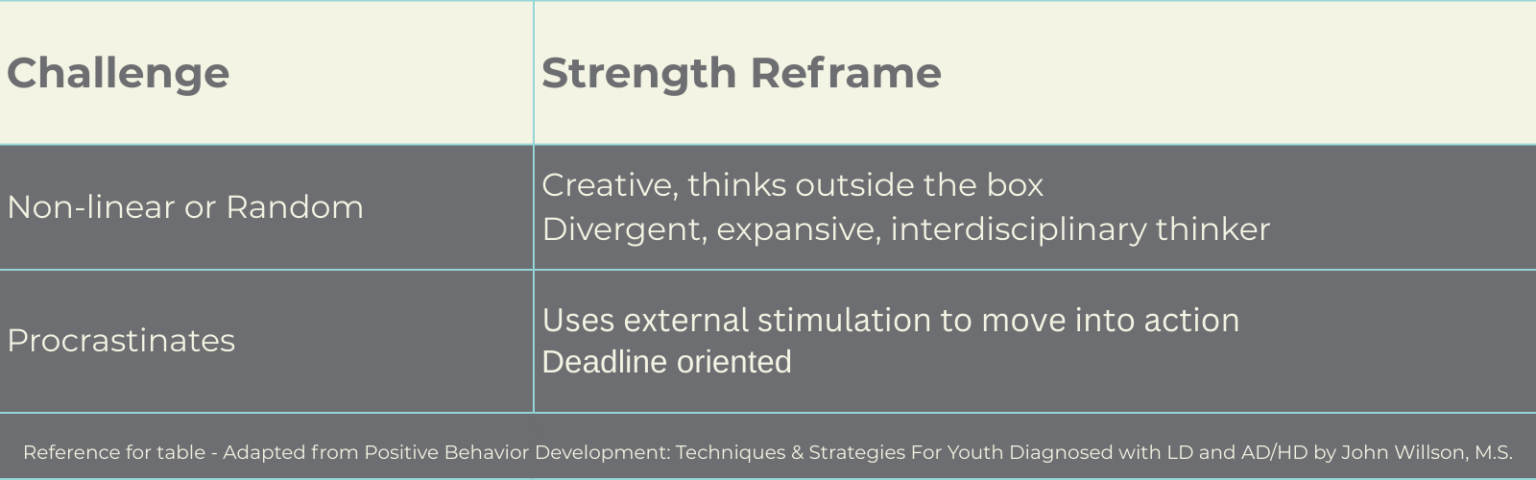
  1. Identify your strengths – for every challenge you see as an ADHDer, try to reframe it as a strength. Reframing allows a supportive emotional response to a perceived misgiving. Here’s an example to get you started:
 
2.  Capture your brilliance – Don’t stop the flow, shape it, lean into your Processing Style to capture your brilliant ideas.
 
Ask yourself, what is the easiest way to record and retrieve the sparks of brilliance that come? Trying to stop the flow of your interest-based nervous system will use valuable energy and attention. This can leave you feeling resentful toward the original passion project, squashing the spark that makes you, you!
 
3.  Develop an external working memory basecamp – lean into your processing style again to help you keep an eye on the big picture.
 
This could be something you devise by writing in a project book on a whiteboard, recording it verbally, and then transcribing, or a visual tool with images or a mind map.
The important part of this for your structure is that you can reignite or revisit your passion with less energy drain and see where you are in the timeline toward it becoming reality for you.
 
4.  Ask “What else do I need to finish strong?” – Finishing strong ADHD style is about knowing your uniqueness and being curious about what supports you.
 
After working with so many unique brains for more than 500 hours, I’ve found that many forget to tap into the resources around them.
I get it, I was the same. Not asking for help and believing that to truly claim success, you have to do it all on your own, or that no one can do it the way you want it done.
You can ask for the support you need by taking one little step: Ask yourself where you need support and what you need.

I would absolutely love to know what the big passions you are bringing to life are.

How might I support you?
If you don’t know and are curious, let’s chat over a free focus session to get your passion project progressing.

With Infinite Peace and Gratitude from,

Carolyn